By Gabby Secretov,
Communications Practice Lead
April 2, 2026
Navigating the AI-First Era: A Communicator’s Start Guide
Actionable insights, sample prompts and real-world scenarios to uplevel your comms skills
We’re experiencing a massive transformation in the world of communications. AI is already impacting everything and the stakes have never been higher for comms teams to not only embrace this tech, but scale its potential. Surprisingly, companies thriving in this new AI-first era aren’t necessarily the ones with the biggest marketing budgets or largest teams. They’re the ones whose comms leaders are quickly embracing AI to revamp current systems and streamline the busywork in order to focus their energy on finding new avenues for creativity, connection and results.
Keep in mind, the foundational skills that matter most in our profession haven't changed: having good judgment, understanding nuance, and navigating complexity. What's changed is that these distinctly human capabilities now have a force multiplier.
Through our work at CōLab, we’re supporting WestCap's portfolio companies and other high-growth startups as they integrate AI into the way they operate. This playbook draws on what I've seen and experienced firsthand, both within our own team and across the portfolio, and is designed to help communications teams start strong and quickly skill up. You’ll find actionable insights, sample prompts and real-world scenarios to use AI for your everyday work and take your communications program to the next level.
The Agentic Future of Communications
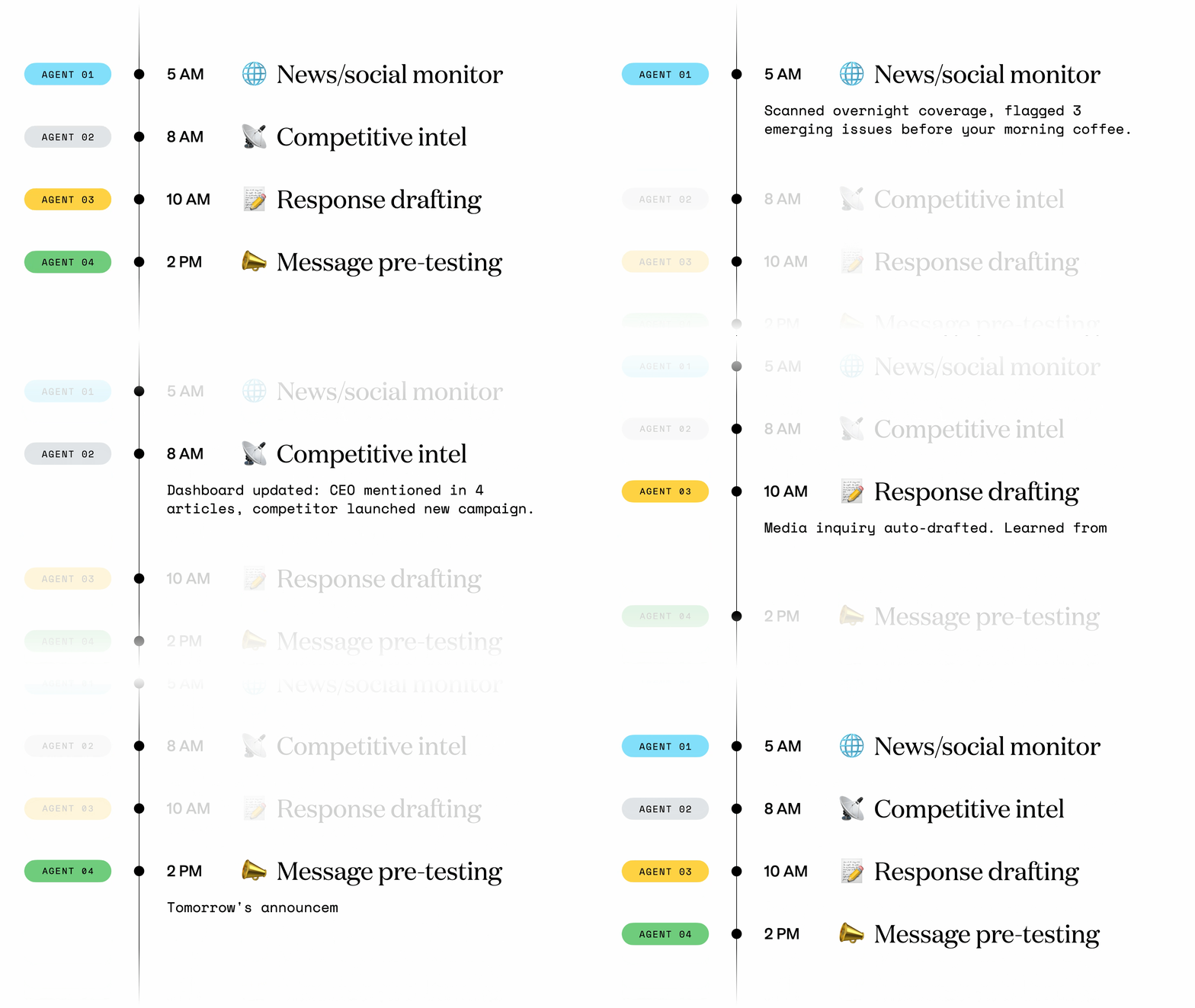
As a comms pro, imagine a day in your life where:
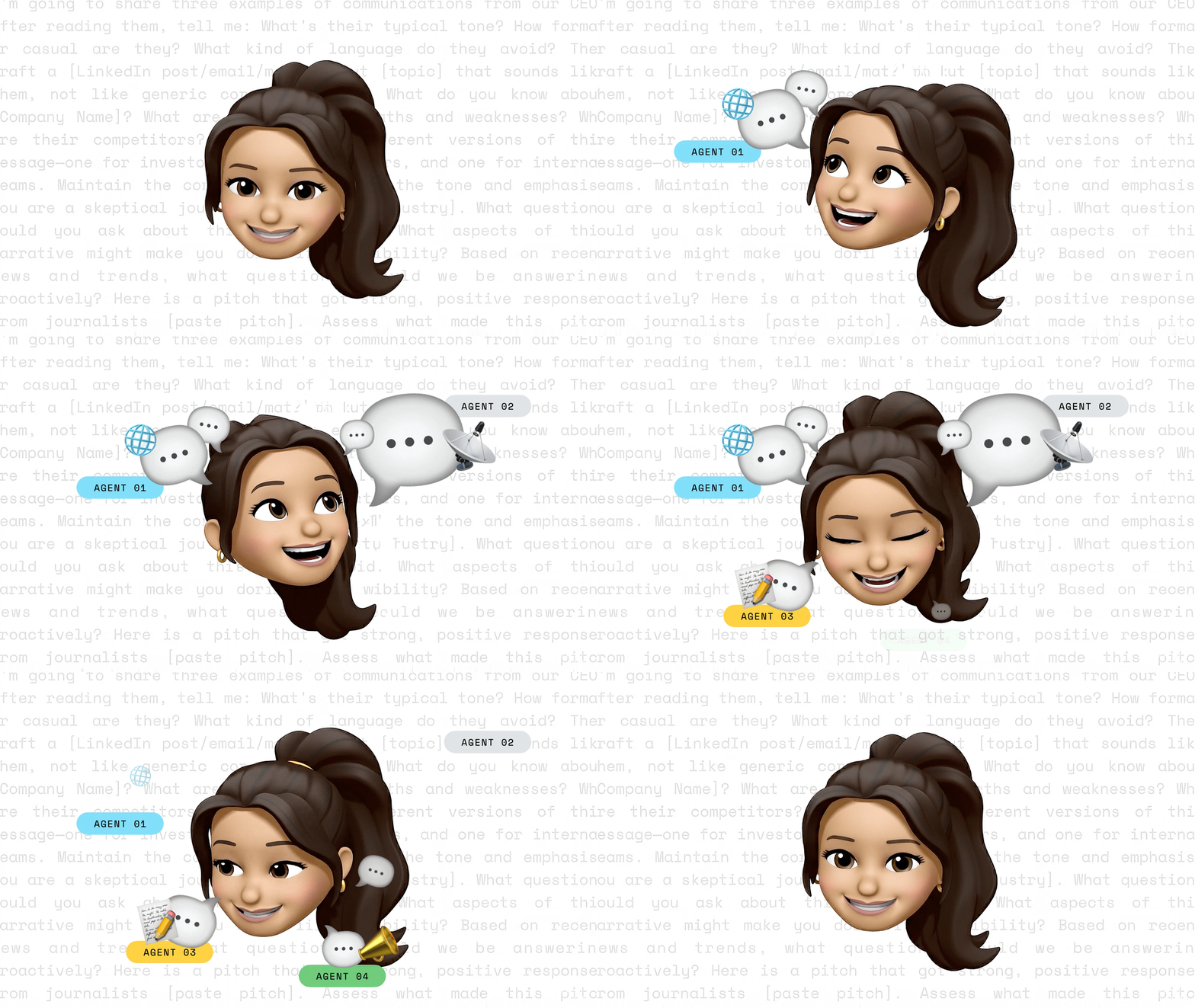
- An AI agent monitors news and social media 24/7, flagging potential issues and relevant trends for your company before your morning coffee.
- Another agent tracks every mention of your executives and competitors, building a real-time competitive intelligence dashboard.
- A third agent drafts initial responses to inbound media inquiries, learning from your edits to get better over time.
- A fourth agent tests messaging across different audience segments, predicting reception before you go public.
Don’t panic if this is far from your reality. The key is to start small, experiment, and iterate. By understanding where AI fits into your current processes, you can begin to unlock its potential. Before diving into specific use cases, we typically guide our portfolio companies to take a step back and build a framework for implementation:
1. Audit your current process 🔍
Break down how you create communications into distinct steps. Where are the bottlenecks? Where does work feel repetitive (low-risk, high volume)? Where do you wish you had more time to think? Map out a typical week and determine how much time goes to formatting, version control, and repetitive tasks vs. developing strategy, understanding your audience, or identifying opportunities to shape the conversation. That ratio tells you where AI can make the biggest impact.
2. Identify your standards 🎨
Before you scale with AI, get crystal clear on voice, tone, and brand standards. AI amplifies what you feed it, but you need to maintain the editorial judgment that separates great communications from content slop. Create a reference document that captures what makes your communications distinctly yours. Include actual examples: "This is how we talk about our product (not like this)." or "Our CEO's voice is direct and unpretentious. We avoid corporate-speak."
3. Create feedback loops 🔄
When AI produces something great, save it and understand why. Was it the prompt structure, the context you provided, or the specific constraints you set? And when it misses the mark, don't just fix it manually and move on. Dig into why it failed: Did you give it enough context about the audience? Was your prompt too vague? Did it need examples to understand the tone? Build a shared repository of "winning prompts" for your team so you never have to start from scratch.
4. Set boundaries 🛡️
Decide with your team what always requires human review. At minimum: anything externally facing, anything sensitive, anything that represents executive voice in high-stakes situations. This ensures that while AI speeds up production, it doesn’t compromise quality or reputation.
5. Monitor your reputation 🪞
What does the AI ecosystem think of your company? Make AI audits a quarterly practice. Compare results across different models and track changes quarter over quarter. If AI is missing key information or emphasizing the wrong things, consider that your content strategy roadmap. Close the gaps with official blog posts, press releases, executive bylines, and data-backed thought leadership. The more credible, structured content you publish, the more accurately AI will represent you. (More on this below in Use Case 2.)
6. Play with new content 🧪
AI opens up opportunities to experiment with innovative formats and delivery methods. A cool example: last year, Klarna used an AI avatar of its CEO, Sebastian Siemiatkowski to deliver its earnings in English, Swedish and German – reflecting the global scale of the company. Experiment with AI-generated explainer videos or infographics to make complex topics more accessible. Start small, gather feedback, and scale successful experiments.
7. Proactively media monitor 🛰️
Track trends and topics relevant to your company, have AI flag articles where your company’s POV could add value. Set up AI agents to monitor trends and topics relevant to your company, flag articles where your voice would add value, and even draft initial pitch angles. That way, you can pitch your relevant news/initiatives to journalists who are still actively reporting on a trend, not three weeks later when the moment has passed.
8. Learn how other team members are using AI 🔗
If HR is using AI to analyze employee sentiment surveys, those insights should inform your internal communications strategy. If product teams are using AI to identify recurring customer complaints, that's your roadmap for external messaging that addresses real pain points. The best comms teams position themselves as the connective tissue across functions, using AI insights from across the organization to be a business driver.
AI isn't just another tool in the toolkit for the communication professional; it represents a fundamental shift in how strategic communications gets done. The trick to effectively using AI in any role is to first understand the workflows, and once you understand the processes involved, you can start identifying friction and opportunities for agentic automation. With that framework in mind, let’s look at how a few pillars across a communications program are already being shaped by AI.
Use Case 1 — Executive Comms: Speed with Soul
75% of comms professionals say they’re already using generative AI for their work – from marketing copy, social media content to other routine communications tasks. But here's the catch: as adoption accelerates, everything starts sounding the same. As we scroll through our LinkedIn feeds, there’s a distinctive, formulaic AI voice that many of us have already started tuning out.
To combat this, teams are increasingly building in-house LLMs that are trained on their executives’ voices, tone, and style (the industry term is “voice agents”). By feeding an LLM an individual’s past communications (e.g. town hall scripts, blogs, interviews), you can produce content that aligns with an executive’s unique voice, whether it’s a sharp and direct tone or one that’s warm and conversational. This means teams can more quickly generate drafts of social posts, press releases, or internal memos that are much closer to being approval-ready right out of the gate.
Try this prompt:
I'm going to share three examples of communications from our CEO. After reading them, tell me: What's their typical tone? How formal or casual are they? What kind of language do they avoid? Then draft a [LinkedIn post/email/memo] about [topic] that sounds like them, not like generic corporate speak.
But again: AI only provides the starting point. As AI makes content easier to produce, human judgment and creativity become exponentially more valuable. The comms leaders who will thrive are those who use AI for efficiency and scale, while maintaining an uncompromising editorial eye.
Use Case 2 — Reputation Management: The AI Mirror
My teammate Diane recently flagged a shift we're seeing in brand discovery: when people have questions about a company, they're asking ChatGPT, Siri or Claude first, not searching Google. SEO still matters, but now there's a new question to answer: what does AI think about your company?" To answer that, we advise our portfolio companies to conduct regular "AI PR audits.”
Try this prompt:
What do you know about [Company Name]? What are their key strengths and weaknesses? Who are their competitors?
The responses will tell you how your company is being represented to the millions of people now using AI as their primary research tool. And if those responses feel off, you need to create more credible, substantial content that accurately represents your company. That means more communication that AI models will recognize as authoritative. This include:
- Leadership posts with clear points of views
- Press releases that establish a track record
- News stories that spotlight your executive or brand
- Case studies with data
Given that large language models are becoming primary information sources, start crafting messaging and corporate communications in a way that's easy for chatbots to understand and accurately represent.
Use Case 3 — Crisis Response: Preparing for the Unexpected
In a crisis, speed and alignment matter. AI can help companies draft reactive messaging faster, anticipate questions from different stakeholder groups, and ensure consistency across channels.
Try this prompt:
Create three different versions of this message—one for investors, one for customers, and one for internal teams. Maintain the core facts but adjust the tone and emphasis.
But even the most advanced AI cannot replace the judgment of skilled communicators. It is up to humans to ensure that a message is delivered within the right context, at the right time, and in the right tone. AI can’t read the room, interpret unspoken dynamics, or sense when silence may be the most strategic move. It cannot perceive the subtle cues (body language, tone or cultural nuances) that determine whether a message resonates or misses the mark. That responsibility lies squarely with us.
Beyond using AI for in-the-moment crisis support, one of the most valuable ways to leverage it is to stress-test your crisis response before you’re in one. This allows communicators to proactively uncover potential weaknesses in their messaging, anticipate tough questions, and refine their approach by simulating real-world scenarios.
Try this prompt:
You are a skeptical journalist covering [industry]. What questions would you ask about this announcement? What aspects of this narrative might make you doubt its credibility? Based on recent news and trends, what questions should we be answering proactively?
These types of exercises can help teams think critically about their messaging, identify blind spots, and prepare for challenging conversations before they occur. It’s not just about anticipating questions—it’s about understanding how to frame answers with credibility and empathy.
AI’s potential in crisis management extends far beyond crafting messaging. It can be a powerful tool for monitoring sentiment, tracking media coverage, and identifying early reputational risks. These applications allow companies to act preemptively, using data-driven insights to adapt their strategies and address concerns before they spiral out of control.
Use Case 4 — Relationship Management: AI as a Force Multiplier
The best communicators have always understood their audiences deeply. The challenge has been scaling that understanding without losing nuance. AI solves that problem, but only if you've done the foundational work first. Who exactly are you speaking to? What's the single thing you want them to do after reading? Answer those questions and AI becomes a force multiplier. Here's what the strategic approach looks like in practice:
- Simplify for clarity: Clarity isn’t about “dumbing down” your writing; it’s about respecting your audience’s time. A simple prompt like, “Rewrite this press release at an 8th-grade reading level,” can force you to refine overly complex ideas and reduce jargon into digestible, impactful language. The worst thing you can do is write about something you don’t fully understand yourself.
- Use AI to role-play critical conversations: Run a town hall script by AI and ask it to prepare some hard-hitting questions from employees. Or ask AI to put itself in the shoes of a board member - what does that person need to know? AI provides an always-available tool to sharpen your message and anticipate tough questions.
- Recognize patterns and replicate success: Some teams are feeding AI examples of their most successful communications that clearly resonated with their intended audiences – for example, marketing emails with high open rates, press releases with strong pickup, social posts that drove engagement – and asking it to identify what worked to replicate success. AI can surface insights you might have missed.
Try this prompt:
Here is a pitch that got strong, positive responses from journalists [paste pitch]. Assess what made this pitch effective and help me write another one about [topic] in the same style.
When leveraged thoughtfully, AI is an always-on partner to help you refine, stress-test, and deliver messages that resonate deeply with your audience.
The Future of Communications
This AI transformation is not just about technology; it’s about mindset. It’s about viewing AI as a partner that can help us scale, uncover insights we might otherwise miss, and reimagine how we connect with our audiences in meaningful ways. Let’s lean into this moment with courage and curiosity. The future of communications is being written right now – and we have a front-row seat.
Want to geek out on how AI is reshaping strategic communications? Reach out on LinkedIn to continue the conversation.

About the author
Gabby Secretov is a communications professional who brings 15 years of PR experience to CōLab, WestCap's in-house creative team. As Practice Lead of Communications, she provides hands-on, embedded support and strategic guidance to startups at every stage of growth. With a passion for storytelling and a self-professed "geek," Gabby translates complex topics into digestible content for business and consumer audiences.
Prior to joining CōLab, Gabby spent several years at FleishmanHillard, partnering with Salesforce, Samsung, Fitbit, AT&T and JPMorgan Chase to develop and execute PR programs in support of product launches, company milestones and thought leadership campaigns.