
By Sadhika Johnson,
Director of Insights
March 13, 2026
Speed Without Sacrifice: How to Deploy AI-moderated Research Responsibly
The rise of AI-powered research platforms promises a revolution: faster, cheaper, and higher-throughput insights. But true to form, researchers are more skeptical (rightfully so), and asking:
🤔 Can AI perform high quality, rigorous research?
🧐 How do you properly vet insights before releasing them into the wild?
🫣 If I use these tools, am I just adding to the ever growing mountain of AI Workslop?
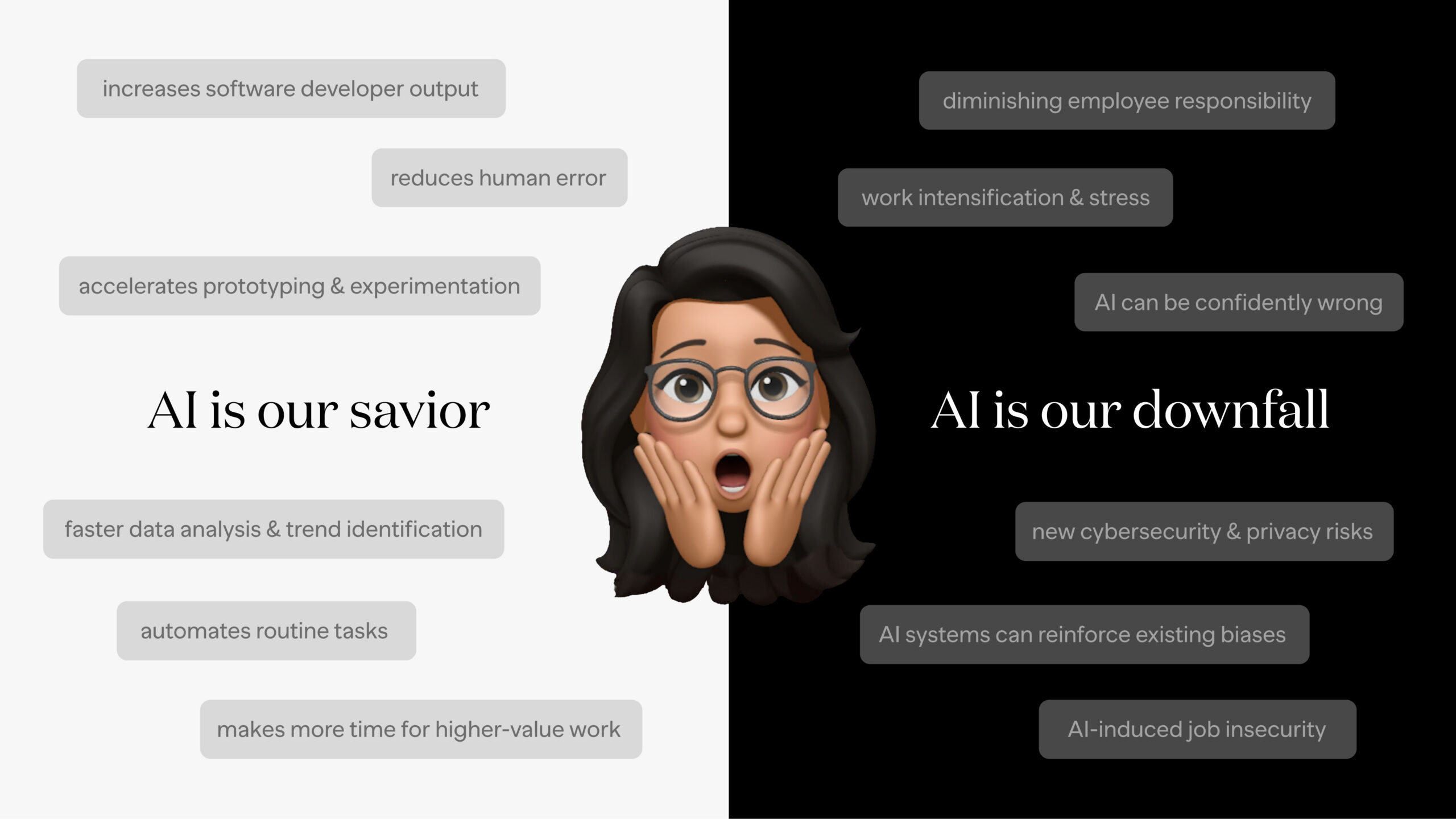
The internet is full of hot takes. From polarized debates on X to heated comments sections on LinkedIn, the consensus is split: AI is either our savior or our downfall. After testing a trendy AI research methodology on a live project, we realized the truth is far more nuanced. AI-powered research isn't inherently good or evil — it’s just incredibly easy to use poorly. Because its promise is powerful, we shifted our focus from hype to handiwork: the path to responsible, high-impact implementation.
As the Director of Insights at CōLab, I spend my days helping founders and executives decode human behavior to make more informed decisions. Whether we’re mapping a complex user journey, segmenting their users, or helping build a new product vertical, the goal is always the same: do robust and comprehensive research, quickly, without sacrificing rigor.
This trade-off between speed and rigor came to a head in a recent study we led for a global fintech company in our portfolio. The goal of our research project was to comprehensively map user workflows across several distinct personas and client segments, comparing users vs. non-users, both on and off the platform. We wanted to capture the breadth of workflows and day-in-the-life of each persona, but also depth within each workflow (triggers, step-by-step tasks, painpoints, tools and tech stack, etc.). Collecting data through an online survey alone would have been cost-effective and covered breadth, but wouldn’t give us the depth within each workflow. A qualitative interview-led approach would allow us to go in-depth, but would have been prohibitively expensive and taken a year to execute. We had three months.
Our solution was a hybrid "high-touch/high-scale" approach:
- High-Touch: On-site client visits and remote video interviews for deep context on individual workflows.
- High-Scale: AI-moderated sessions to capture workflow data across a massive, diverse audience.
AI moderation in research refers to using AI —specifically natural language processing and generative AI — to autonomously conduct qualitative interviews, surveys, or focus groups. AI moderators interact with participants in real-time by asking follow-up questions, probing for deeper insights, and adapting conversation flow based on answers, providing speed, consistency, and scale at reduced costs.
This is my honest download on AI moderation after utilizing it for this project: what worked, what didn’t, where AI moderation shines, where it absolutely shouldn’t be used, and practical tips for teams trying to do this responsibly.
What worked well
The efficiency gains of AI moderation are undeniable. Here’s what worked exceptionally well in our study:
1. Unprecedented scale and speed
Once we got through the initial setup, the throughput was incredible. As a single researcher on this project, I was able to run 42 total interviews across 4 personas, 4 segments, covering users and non-users. This level of breadth would be prohibitively expensive and time-consuming with purely human moderation.
2. Consistent data collection
AI moderation results in a more consistent participant experience, reducing bias introduced by a human's energy levels, rapport-building style, or subtle variations in probing, ensuring a cleaner, more standardized dataset.
3. Chat-based synthesis was a game-changer
Especially in later stages of synthesis, I could ask highly specific questions about audience groups, and get summarized insights with direct, substantiating quotes. This is where AI truly shines, allowing for deeper synthesis across custom cuts instantly.
What didn’t work so well
The speed of these tools is precisely what makes them dangerous if used uncritically. Our experience highlighted several significant friction points:
1. AI-moderation is rigid and lacks depth
There were points where the AI didn’t go as deep as I would have, or failed to follow an interesting, unscripted thread that could have led to a novel insight. If you haven't hard-coded every possible area to probe, you risk missing out on valuable insights, because the AI can't pivot on human curiosity.
2. Low quality auto-generated outputs
Many tools aim to deliver a “finished” output, i.e., complete reports with key learnings, supporting quotes, charts, and visuals. In practice, these auto-generated outputs are often surface-level at best, and actively misleading at worst. In one case, the report elevated a single outlier response as a headline insight, drawing attention to a niche edge case while obscuring findings with broader support. Elsewhere, it presented percentage-based statistics without any reference to sample size, despite the study being qualitative in nature.
Researchers are trained to distinguish signal from noise and to question whether patterns are statistically or methodologically meaningful. Most people are not, which is precisely why raw, unfiltered AI outputs can be dangerous in the hands of non-researchers.
Once an insight or numbers appear on a slide, stakeholders tend to treat them as true and statistically meaningful, regardless of whether the data or methodology can actually support that conclusion. Instead of pretending to replace researcher judgment, these tools are far more useful when they function as data exploration tools: helping teams slice, filter, and interrogate the data faster, while leaving interpretation where it belongs – with the researcher.
3. Theme categorization looked slick, but was untrustworthy
On the synthesis side, the platform auto-categorized themes and showed overall counts per theme and breakdowns per persona. For a seasoned qualitative researcher, this is an incredibly enticing promise – you mean I don’t have to spend hours manually coding and categorizing qualitative data?
In practice, however, the execution fell short. In our study, the theme counts were often incorrect, and changing one theme would reset all the themes and counts. At that point, the entire quantitative layer of the synthesis became suspect. I ended up doing my own counting and categorization, using the tool more as a data browser than an insight engine.
This pattern reflects a broader issue across many new research tools: LLM-powered automation is often applied as a blanket solution across synthesis, without sufficient consideration of how researchers actually work. A more effective approach would pair automation with control, for example, a drag-and-drop, card-sorting-style interface that allows researchers to actively group quotes into themes, while automatically surfacing reliable summary counts at the top.
4. Participant experience felt clunky
Participants often had to repeat themselves because the AI didn't register a piece of information mentioned in the context of a previous question, leading to a frustrating, impersonal experience.
5. Long and cumbersome set-up
Since this was our first study of this kind, we encountered unexpected challenges in the setup process. Configuring the persona framework and segment definitions was more complicated than expected. The interview guide required extensive testing to ensure the AI moderator could probe effectively, avoid repetitive questioning, and handle edge cases without breaking down.
The project ultimately delivered on time despite the delays, because I had built in what I believed was an ample buffer, but we ended up using nearly all extra time to account for the quirks of a new method and tool.
TL;DR
AI moderation can be a fantastic force multiplier if used in the right context and with appropriate guardrails, but can be a dangerous shortcut if used carelessly. Used well, it can unlock scale, consistency, and speed. Used blindly, it can generate beautifully packaged, confidently wrong insights that quietly steer decisions off course.
Practical Tips for Using AI-Moderated Research Responsibly
1. Treat AI-Moderation as one method in a mixed-methods study design.
Don’t let it replace human conversations entirely. Before launching a large AI study, build your foundation by doing some interviews the "old school" way (in person or remote video). This grounds you in user needs, helps you catch mistakes/hallucinations in the AI synthesis, and informs a much sharper and comprehensive AI discussion guide.
2. Don’t skimp on the synthesis
There’s a common assumption that AI moderation will multiply research output, because we can churn out “polished” reports at the push of a button. In practice, that expectation is unrealistic. While there are meaningful time savings, they show up primarily in data collection — running many interviews concurrently across diverse participant criteria. In my experience, this dramatically expanded the scale of the research, compressing what would normally take months of fieldwork into a matter of weeks.
What didn’t disappear was the work of synthesis. Interpreting the data, separating signal from noise, and identifying insights that truly matter still takes time if it’s done well. Auto-generated insights can be a useful starting point, but the real value of these tools lies in making the data easier to explore and interrogate. AI can accelerate the work, but it shouldn’t be doing it for you.
Some practical tips for synthesis:
- DON’T use autogenerated insights directly without triple checking them
- DON’T use theme counts or percentages directly from the interface
- DON’T export charts without annotations
- DON’T confuse polish with accuracy
- DO use autogenerated reports as a jumping off point for deeper analysis
- DO use chat-based synthesis to compare user groups or personas
- DO read individual responses in full to understand participant mindset in full (not piecemeal)
- DO control who has access to auto-generated outputs, especially outside research teams
3. Educate your teams and stakeholders
AI-powered research offers unparalleled efficiency in data collection and retrieval, but the tools are in their infancy. At the same time, leaders everywhere (especially non-researchers) are excited at the expected efficiency gains.
Speed of the tool + polish of outputs - human verification = Dangerously misplaced trust
We need to educate teams and stakeholders on:
- When and where to use AI-moderation
- Interrogating auto-generated insights
- Double-checking sample sizes and statistical validity
- How to make the best use of the tools at hand (and where to steer clear)
- Setting accurate expectations on timeline and deliverables (e.g. don’t expect lightning fast outputs, because we need sufficient time to interrogate and validate the findings)
4. Build guardrails for when and why to use AI-moderation
Best For AI Moderation
Iterative Testing Cycles. These tools make it really easy to collect quick feedback on new ideas or concepts, making them a great fit for iterative testing cycles, concept testing following a design sprint.
Tactical Research with clear, simple objectives (e.g., usability testing, creative testing).
Qual-Quant Hybrid. Achieving the robust sample sizes of a survey with qualitative depth.
High Throughput, global and multi-lingual: International research studies done the old school way can cost 10s of thousands of dollars, factoring in hiring moderators in multiple languages, research facilities, recruitment agencies, etc., making them prohibitively expensive. AI moderated platforms brings it down.
When to AVOID AI Moderation
Exploratory / Generative Research (e.g., brand discovery, early-stage innovation). These studies rely on human intuition, curiosity, and the ability to pick up on subtle cues and body language. The most impactful insights in this space emerge when the researchers go in open-minded, with a flexible interview guide, pivoting where needed to follow an interesting thread. The programmatic nature of AI-moderation creates limited opportunities to discover unknown unknowns.
Emotionally Charged/Sensitive Topics. AI moderation feels impersonal and lacks trauma awareness and empathy. People may feel uncomfortable discussing sensitive topics if they don’t feel a human correction. Further, participant discomfort may go unnoticed by the AI moderator, which could cause distress and potentially retraumatize participants.
The Bottom Line
AI-moderated research isn’t going to replace researchers. What it will replace is slow, bloated, logistics-heavy projects and endless back-to-back interviews where a human adds value little beyond reading a script.
If we use these tools thoughtfully, researchers become more strategic, spend more time on framing, synthesis, and storytelling; and less time on scheduling, transcription, and manual slicing.
We need to be clear-eyed (with ourselves and our stakeholders) about what AI-moderated and synthesized research does well, where it breaks down, and how to use it without compromising rigor.
AI should enhance research, not hollow it out.

About the author
Sadhika Johnson is CōLab’s Director of Insights, and our resident “people-nerd.” Using methods in the domains of experience research, design thinking, and product management, she helps founders and executives make more informed decisions, and ultimately build better products. Prior to joining CoLab, Sadhika was at Airbnb, where she helped establish the Consumer Insights function, worked across the product life cycle, and led foundational research and strategic thinking to understand new problem spaces and verticals (e.g. Frontline Stays, Unique Stays). Over her nine years at Airbnb, she facilitated numerous workshops, design sprints, and strategy sessions to ensure alignment and help teams execute on a shared base of insights.